
Attentively Eat Away Bulge
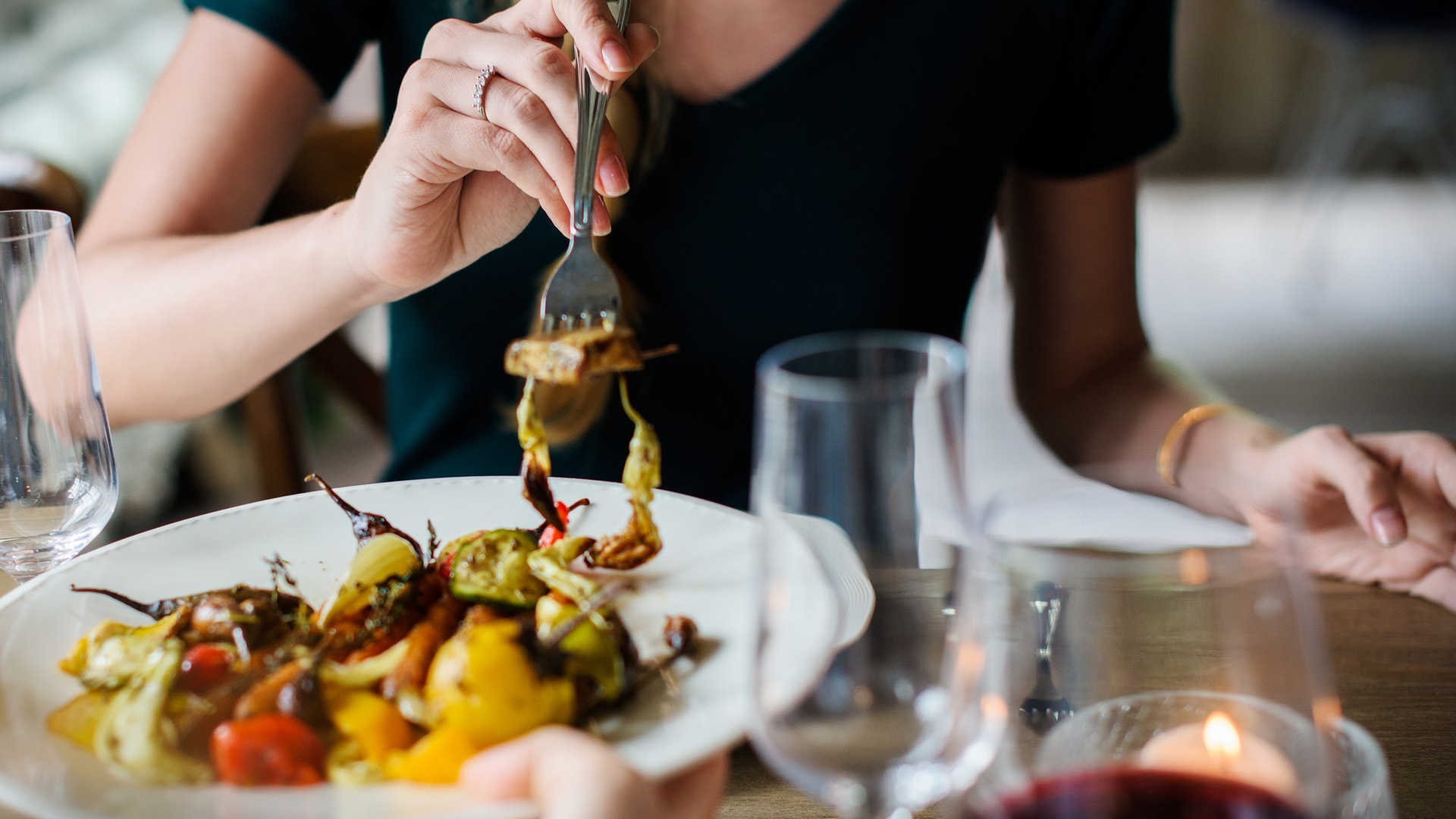
Masses of tasty sweet and savoury treats. They've been devoured. Instantaneously. With lots of "ooh, that's good" and "umm, have you tried that?" remakes. Finger foods and bite-sized morsels of magic and brunches and lunches and three-course meals all washed down with a favoured tipple.
And then I was halted just as I placed a rich chocolate in my mouth...

...'Don't bite it!' I was directed. 'Let it melt in your mouth. And enjoy the silky smooth chocolate as it coats your mouth.'
I'd never sat back and savoured a chocolate before. Popping it in and chomping away as the chocolate smeared the side of my mouth, before swallowing and then reaching for another was my thing. This was new.
Admittedly, I felt a little uncomfortable. Eyes gazing at me looking for admiration and endorsement. The chocolate wrapped in gold and black demanded luxury and so did my friend. I waited for the heat of my mouth to gently warm and soften the sweet. As it did, my tongue began to play with the ever decreasing shape. The flavours began to reveal and its texture layered. It was a happy moment. Followed by, 'umm, that's nice.'
Over the last week, I've paid more attention to every chocolate... which was a lot! While enjoying it, I've tried to verbalize the sensations. Not very eloquently I might add. But my enjoyment and understanding have been elevated. I don't simply rely on reactive responses - I eat, I'm stimulated, I want more. Instead, I'm applying my human and being present at that moment.
Which got me thinking about the mental and emotional and physical effects...
...could slowing down & appreciating food help battle the bulge?
Well, I've read many professional claims. Many positive. Some casting doubt. The truth of the matter is that the science is young while the practice is ancient. Therefore, it's difficult to prove anything. Nevertheless, the practice is proving popular. Many are dabbling with mindful guidance. They are taking hold of foods - really feeling it, seeing it, smelling it, and tasting it. People are slowing down and experiencing foods.

Be that as it may, becoming mindful of your food may not be possible at every meal, every day. But mindful eating lessons will stay with you. The knowledge could help you make better future decisions. And when you do have the time to put the method into practice instead of shovelling down your meal to get back to work, you'll not only enjoy what you're eating but reinforce the teaching.
Naturally, there are concerns. Dr Katy Tapper, City University of London, questions if the techniques involved could, in fact, cause people to eat more food. Due to the power of junk foods overriding our fullness response, it is a possibility.
Doctor Tapper queries if 'this strategy could cause someone to eat more when they’re not hungry because food can be pleasurable even when we’re full, such as when we eat dessert after a large main course. It may also have little effect on those who are dieting if they are already restricting their portion sizes (and getting them to focus on sensory pleasure could make them forget about their weight-loss goals).'
It would seem, nothing's 100% full proof... especially if you're jamming together strategies.
To be clear, a mindful eating technique was forced upon me, to savour the flavour. And I appreciated it because I've often been left wanting more after a tiny dense delight quickly passes my lips. This way I'm satisfied with what I've had and I can choose my next response...
...I want another one but do I need it?
Actually, a lot of the solutions to overeating and losing weight come from the choices we make. In the Doctors example, the dessert needs to be available. You'd have to be overly stimulated by your dinner. And then you have to choose to take it. In a restaurant or at a dinner party, we're conditioned by social cues. You can politely decline but it takes forward thinking and follow through.
However, if you decide to take the dessert, I cannot see how enjoying every moment of your dinner and dessert will cause binge eating if using mindfulness doesn't stop there.
Also, if you're home and contesting a desert, then using the power of your brain can help you win. Either way, that dessert's either part of your diet and you eat it, or maybe you're full and decide not to eat it (well done you), or it shouldn't be there in the first place.
Furthermore, Dr Tapper's concern over dieters throwing out their weight-loss goals because they're overstimulated and underfed only highlights a common dieting fallacy... portion sizes. If you've made any of the delicious recipes we've provided, then you'll know portion sizes are not restricted. In reality, they're bigger than most meals. In truth, the size isn't the issue, the energy density and nutrition are.
So, if you are left continuously hungry and attempting to relish the food you're eating, then it's likely you're going to crave more. The smart thing to do is to reject the typical eat less and do more mantra because it simply does not work in the long run.
In my experience, stopping and thinking often helps me make better decisions. By taking note and acting accordingly, I can head down the right path. As I said before, nothing's full proof so don't beat yourself up if you slip up now because the next meal or snack is ticking ever closer and you will make the right decision.
Proof Mindful Eating Changes Behaviour
Regardless of my views, the academics want proof. They want hard data to show that listening to physical hunger cues and distinguishing between actual hunger and non-hunger triggers actually stops you from eating more than you should. Or eating slowly and eating only until you're full connects you with food and limits your intake.
In fact, there is a study, Mindfulness-Based Interventions for Obesity-Related Eating Behaviors: A Literature Review. They filtered through thousands of papers and ended up with twenty-one that met the criteria. And out of those studies, eleven that targeted binge eating reported improvements in binge eating frequency and severity. Five interventions that targeted emotional eating resulted in positive changes. Episodes of emotional eating and the urge to overeat reduced. Four studies that looked at external eating reported frequency improvements in eating in response to environmental food-related cues, such as the sight or smell of food. And nine studies noted weight loss. However, there's a lack of studies to support using mindfulness techniques to change your diet.
Overall, this review found positive results. From a variety of mindfulness techniques, such as a combination of cognitive behavioural practices and acceptance-based programs, eating behaviour changed.
Although, it's worth pointing out that most of the papers did not define a mindful system. And only half of the studies actually measured changes in mindfulness even though there are several tests they could have easily followed. Therefore, it's difficult to determine if mindfulness was the driving force behind the changes.
All in all, you generally cannot go wrong making conscious decisions. And if slowing down for a moment to enjoy your food and then appreciate what you've just eaten helps you lose weight, there's no harm done.